

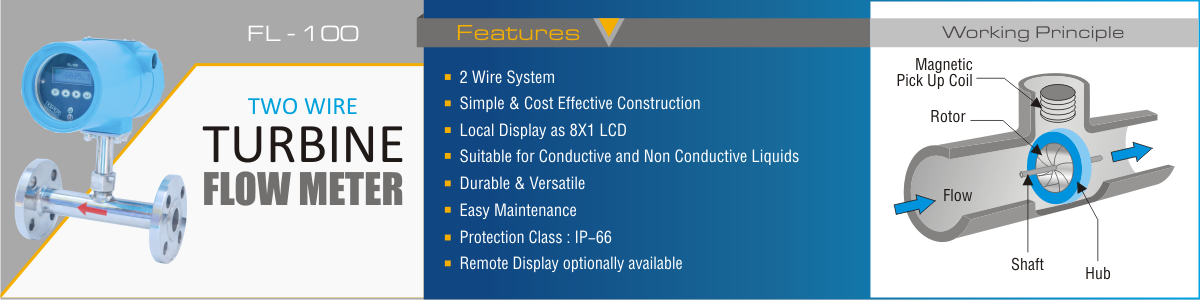
The Turbine Flow meter is used for the measurement of liquid flow rate. It works on the principle of Turbine. A turbine flow meter is constructed with rotor and blades that use the mechanical energy of the fluid to rotate the rotor in the flow stream. Blades on the rotor are angled to transform energy from the flow stream into rotational energy. The rotor shaft spins on bearings - When the fluid moves faster, the rotor spins proportionally faster.
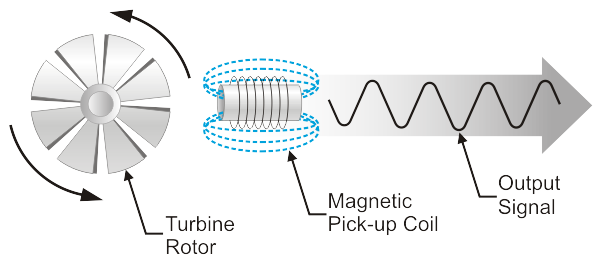
Electronet series FL-100 are Two Wire Turbine Flow Transmitters specially used for various industrial applications. The flowing media engages a vaned rotor causing it to rotate at an angular velocity proportional to flow rate. The pick-up coil senses the spinning motion of the rotor inside the pipe & converts it into a pulsating electrical signal. Summation of the pulsating electrical signal is directly related to the total flow.
The frequency is linearly proportional to flow rate which is converted to electrical signal 4 - 20 mA. Turbine flow meters are preferred for clean, filtered, low viscosity fluids. The typical accuracy and repeatability of turbine flow meters are ±0.5% and ±0.1%, respectively. However, it is possible to achieve accuracy of ±0.25% and repeatability of ±0.05%.
Turbine flow meters are inherently sensitive to Reynolds number. They will not be linear at Reynolds numbers nearing or in the laminar region. Therefore, they should be carefully used in the case of fluids with a broad temperature and viscosity range such as some oils. It is not a problem at constant conditions, but is often hard to achieve practically.
 |
 |
| Food Industry | Chemical Industry | Atomic Energy | Manufacturing Industry |
| Automation Industry | Thermal Power Energy | Process Industry | Water Treatement Industry |
